
Follow Acrtools
Menu
Your Cart

Automotive Air Conditioning Products

Automotive Air Conditioning Products

AUTOMOTIVE AIR CONDITIONING – PRODUCTS

By installing an air conditioning unit in a vehicle, our aim is to ensure that the conditions inside the passenger compartment remain comfortable and healthy, particularly during the summer months.

For an air conditioning system to operate efficiently, the refrigerant must circulate continuously within a closed system. For this reason, all air conditioning systems use the same refrigeration cycle, consisting of compression, condensation, expansion and evaporation in a sealed circuit.

The refrigerant transfers heat from one area to another, thereby cooling the first area. As shown in the diagram below, the refrigerant operating cycle consists of four stages. The system is divided into a high-pressure area and a low-pressure area, depending on the refrigerant pressure. 

Description of the Refrigeration Cycle – Starting with the Compressor

  1. The refrigerant enters the compressor (1) as a low-pressure gas. It is compressed and discharged as a high-pressure gas. This gas then flows towards the condenser (2).

  2. Inside the condenser, the gas changes into a liquid, releasing heat into the outside air. The liquid then moves towards the evaporator (4), also known as the evaporator coil.

  3. As the refrigerant passes through the expansion valve, its pressure decreases. The low-pressure liquid then flows towards the evaporator (4).

  4. Inside the evaporator, heat from the air in the area being cooled is absorbed by the refrigerant, causing it to change from a liquid into a gas (vapour). The refrigerant, now in the form of a low-pressure gas, flows back towards the compressor (1), and the cycle starts again.

Particular emphasis must be placed on the role of the compressor in the refrigeration system. Without compression, the refrigerant gas (vapour) cannot condense in the high-temperature section, allowing the cycle to repeat. The expansion valve also plays an equally important role. If the liquid refrigerant is not expanded and instead enters the evaporator as a high-pressure liquid, evaporation cannot take place effectively.

Cooling Capacity 

The above processes are based on the Second Law of Thermodynamics as applied to refrigeration systems, which states that heat cannot be transferred from a body at a lower temperature to a body at a higher temperature without the input of external work.

This means that:

Heat Rejected = Cooling Capacity + Compressor Power

In other words, the heat released into the surrounding environment during the operation of a refrigeration system equals the sum of its cooling capacity and the power required to drive the compressor.

The cooling capacity of a system is defined as the amount of heat removed from a space per unit of time.

The units of measurement used are:

  • Technical System (TS): 1 kcal (kilocalorie).
  • British System: 1 BTU (British Thermal Unit).
  • 1 kcal/h = approximately 4 BTU/h = 0.86 kW.

Description of an Automotive Air Conditioning System

But how does the system work? 

Power is transmitted from the crankshaft pulley to the compressor pulley. When the air conditioning switch on the vehicle dashboard is activated, the compressor starts operating. The compressor is the main component of the air conditioning system, as the overall system performance depends largely on its efficiency.

The compressor is mounted on a special bracket attached to the engine and is driven by a belt. A belt tension adjustment system is usually provided to prevent slipping and ensure proper operation.

The compressor draws in the FREON refrigerant gas and compresses it, increasing its pressure. It then sends it to the condenser, a second radiator positioned in front of the engine radiator.

With the assistance of an electric cooling fan or the airflow generated while the vehicle is moving, the refrigerant is cooled until it turns into a liquid.

After passing through the receiver-drier filter, which retains any moisture and impurities, as well as refrigerant residues, the liquid refrigerant is directed towards the expansion valve, located very close to the evaporator.

The purpose of this component is to reduce the pressure of the liquid refrigerant, allowing it to evaporate easily inside the evaporator while absorbing heat from the surrounding air.

At the same time, a fan blows the cooled air into the passenger compartment through the air vents, which are also used by the vehicle's heating system.

It should be noted that the evaporator is installed in a specially designed position inside the vehicle's heating and ventilation unit, always before the heater core.

The main problems associated with the first automotive air conditioning systems were related to their compressors. These systems used general-purpose, low-efficiency reciprocating compressors that required considerable power to operate.

Depending on the compressor type, it is activated through an electromagnetic clutch and driven by a belt connected to the engine crankshaft.

The required power corresponds to an engine power loss of approximately three to seven horsepower.

Engine fuel consumption increases only in proportion to this additional load, since the air conditioning system is connected to the engine's electronic control unit (ECU), which recognises the additional load and adjusts the fuel mixture accordingly.

Today, various advanced and high-technology compressor types are available, designed to operate with improved efficiency and reduced power consumption (approximately three to seven horsepower, depending on the compressor's cooling capacity).

Wind tunnel research has shown that, at medium and high speeds, an air conditioning compressor can consume 20% to 50% less energy than driving with an open window or sunroof.

When the vehicle engine is idling, the available power may not be sufficient to drive the compressor efficiently. For this reason, independent air conditioning manufacturers provide a special mechanism for aftermarket air conditioning installations. This mechanism is fitted to the engine's fuel supply system and increases the idle speed when the air conditioning system is operating.

It is also worth noting that the air conditioning system does not operate continuously. Its operation is controlled by a thermostatic valve, which automatically switches off the compressor when the air inside the vehicle reaches the desired temperature.

The cooling capacity of automotive air conditioning systems varies from one vehicle model to another. It is relatively high in relation to the passenger compartment volume and typically ranges from 15,000 BTU to 23,000 BTU.

This high cooling capacity is justified by the considerable heat load and heat losses affecting the passenger compartment, as well as the need for rapid cooling.

Brand: ACRTOOLS (PL products) Model: 11.01.012
"PAG 100" Lubricant 1L ACRTOOLS Ideal for the lubrication and maintenance of air conditioning and refrigeration systems...
Brand: Other Model: 11.02.255
"ZEROL ICE LT " - ESTER ( 250ml ) Oil Enhancer for low temperature applications (refrigeration) SHRIEVE The "ZEROL ICE LT" - ESTER (250ml) oil enhancer by SHRIEVE is specifically designed for refrigeration and other systems operating at low temperatures. It uses an Ester formulation to provide ex..
Brand: Other Model: 11.02.250
"ZEROL ICE" A/C Oil Enhancer med/High (250ml) for air conditioning applications SHRIEVE Excellent refrigerant oil enhancer for use in car air conditioning compressors. A thin film protects the compressor's moving parts from wear, minimizing damage, maximizing car performance due to reduced resist..
Brand: ACRTOOLS (PL products) Model: 10.30.340
1/4" Female (R12) to R134a Automotive High-Side Adapter Red HI910-694 ACRTOOLS Adapter for the high side of a vehicle's FREON system, converting from R12/R22 to the newer R134a type. The automotive A/C service port retrofit adapter can help you replace the old R12 service port with a newer R13..
Brand: ACRTOOLS (PL products) Model: 10.30.341
1/4" Female (R12) to R134a Automotive Low-Side Adapter Blue 910-695 ACRTOOLS Adapter for the low side of a vehicle's FREON system, converting from R12/R22 to the newer R134a type. The automotive A/C service port retrofit adapter can help you replace the old R12 service port with a newer R134a ..
Brand: MASTERCOOL Model: 09.08.030
69925 MULTIPLE FLUSHING & LEAK TEST ADAPTER KIT FOR FLUSH MACHINE MASTERCOOL USA Multi-purpose leak test and flushing adapters suitable for more than 80% of the automotive air conditioning systems in the market! Isolates A/C system components for closed loop flushing Flush individual ..
Brand: MASTERCOOL Model: 09.08.051
82834-E High Side Manual R134a 1/4" FL-M x 16mm MASTERCOOL USA *Sold by the piece. R134a Manual High-Side Quick Coupler (1/4" FL-M x 16 mm). High-Side Manual R134a 1/4” FL-M x 16 mm Quick Coupler Adjust easily to R134a service ports with varying dimensions All metal construction for ..
Brand: MASTERCOOL Model: 09.08.050
82934-E R134a - Manual Low Side Quick Coupler (1/4" FL-M x 13 mm) MASTERCOOL USA *Sold by the piece. R134a Manual Low Side Quick Coupler (1/4" FL-MALE x 13 mm). 1/4" FL-MALE x 13 mm All metal construction for extra durability Patented, spring loaded depressor will not ..
Brand: Other Model: 10.30.605
A/C Compressor Gasket Kit for SANDEN 505 / 507 / 508 / 510 ΟΜEGA High-quality gasket kit for Sanden SD505, SD507, SD508, and SD510 air conditioning compressors, designed to restore the sealing integrity and proper operation of the A/C system...
Brand: Other Model: 10.30.601
A/C Compressor Gasket Kit for SANDEN 709 Series FIBER R12 & R134a OMEGA Suitable for air conditioning systems using R12 and R134a refrigerants, covering a wide range of both older and newer applications. ..
Brand: Other Model: 10.30.604
A/C Compressor Gasket Kit for SANDEN GASKET ΚΙΤ YORK OMEGA Features & Benefits: Effective sealing and protection against leaks. Designed to restore the sealing integrity and proper operation of the A/C system. Ideal for the repair, maintenance, and rebuilding of air conditioning com..
Brand: Other Model: 10.30.602
A/C Compressor Gasket Kit for SANDEN SD505 / 507 / 508 / 510 FIBER R1 OMEGA Suitable for air conditioning systems using R12 and R134a refrigerants, covering a wide range of both older and newer applications...
Brand: Other Model: 10.30.603
A/C Compressor Gasket Kit for SANDEN SD505 / 507 / 508 / 510 ΟΜEGA High-quality gasket kit for Sanden SD505, SD507, SD508, and SD510 air conditioning compressors, designed to restore the sealing integrity and proper operation of the A/C system. ..
Brand: Other Model: 10.30.600
A/C Compressor Gasket Kit for SANDEN SD7 Series (7458-9610) OMEGA Features & Benefits: Meets or exceeds Original Equipment (OE) specifications. Durability tested for reliable performance under extreme operating conditions. Engineered for enhanced performance. Direct replacement fo..
Brand: Other Model: 10.30.058
Accessory for Automotive Hydraulic Hose Press #10 Omega The Omega accessory for the #10 automotive hydraulic hose press is a reliable and durable tool for pressing and connecting automotive hoses. Designed for professional and personal use, it ensures consistent, precise, and safe results in ever..
Brand: Other Model: 10.30.056
Accessory for Automotive Hydraulic Hose Press #6 Omega The Omega accessory for the #6 automotive hydraulic hose press is a reliable and durable tool for pressing and connecting automotive hoses. Designed for professional and personal use, it ensures consistent, precise, and safe results in every ..
Brand: Other Model: 10.30.057
Accessory for Automotive Hydraulic Hose Press #8 Omega The Omega accessory for the #8 automotive hydraulic hose press is a reliable and durable tool for pressing and connecting automotive hoses. Designed for professional and personal use, it ensures consistent, precise, and safe results in every ..
Brand: ACRTOOLS (PL products) Model: 09.08.065
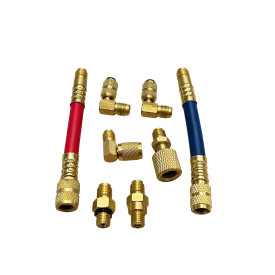
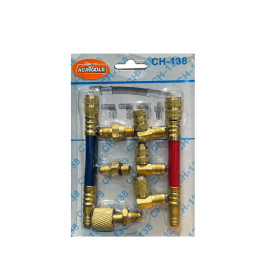
Auto A/C Adaptor Valve Set (8 pcs) CH-138 ACRTOOLS *Sold as a set of 8 pcs. CH-138 8-piece adaptor set for Auto A/C, designed for easy connection of hoses and charging equipment to automotive air conditioning systems, featuring different types and sizes of connections...
Brand: Other Model: 10.30.520
AUTOMOTIVE A/C ACCUMULATOR FILTER FOR GM LATE NICKEL OMEGA Features: Type: Accumulator / A/C Filter Suitable for GM (Late Model) applications High-strength aluminum construction Protects the compressor from liquid refrigerant Removes moisture and traps contaminants Helps maintain ..
Brand: Other Model: 10.30.752
Automotive A/C Idle Control Component (Electromagnetic Triple Unit) OMEGA Automotive A/C Idle-Up Component (Electromagnetic Triple Unit).  ..
Brand: Other Model: 10.30.751
Automotive A/C Idle Control Component (Universal Actuator Puller) OMEGA Automotive A/C Idle Control Component (Universal Actuator Puller). Thanks to its universal design, it is suitable for a wide range of applications in passenger, commercial, and specialty vehicles. Its durable construction ..
Brand: Other Model: 10.30.750
Automotive A/C Idle Control Component (Universal Actuator Pusher) OMEGA Automotive A/C Idle Control Component (Universal Actuator Pusher). Thanks to its universal design, it is suitable for a wide range of applications in passenger, commercial, and specialty vehicles. Its durable construction ..
Brand: Other Model: 10.30.502
Automotive A/C Receiver Drier Long 3/8" #3/8 MF3.00 #10.13 OMEGA TECHNICAL SPECIFICATIONS: Inlet: 3/8" MIO Outlet: 3/8" MIO Diameter (DIA): 3.00" Length: 10.13" Desiccant Capacity: 13.20 cu in Special: SG (Very Heavy Duty)  ..
Brand: Other Model: 10.30.509
AUTOMOTIVE A/C RECEIVER DRIER LONG 3/8" FOR HONDA ACCORD OMEGA TECHNICAL SPECIFICATIONS: Inlet: 3/8" MIO Outlet: 3/8" MIO Diameter (DIA): 2.50" Length: 9.50" Desiccant Capacity: 3.50 cu in Special: FP..
Brand: Other Model: 10.30.377
Automotive A/C Valve Core for R134a RV-10-3 / 910-1209 OMEGA *Sold by the piece.  The thread is located at the top and features a thin gold-colored design. Ensures reliable sealing, durability in use, and proper operation of the A/C system...
Showing 1 to 25 of 182 (8 Pages)
Antagonistikotita Frame